The only shortage is one of greater fools; Prices start to fall.

July 30th, 2010

We are continually told that a shortage of houses means prices will continue to out pace the buyer’s ability to afford them, and that money grows on trees.

However two other shortages are starting to show its head in Australia’s property bubble. The shortage of greater fools - someone that will buy a property for more than what you brought it for is causing auction clearance rates to tumble and prices to drop.

According to RP Data-Rismark figures released today, house prices are on the decline, falling 0.8 percent in June, and the largest fall since April 2008. The lack of greater fools were the most in Perth, where prices fell 2.5 percent, followed by Brisbane which fell 1.3 percent.

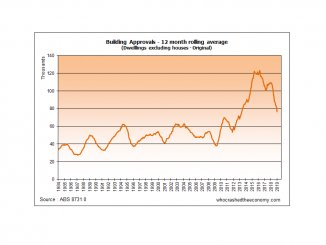
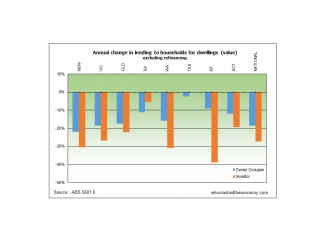
The shortage of greater fools has been caused partly by another shortage, one of credit and evident by a plunge in mortgage approvals this year. Australia has been in a credit crunch since January, after many of the banks dropped Loan Value Ratios (LVR) to around the 80 percent mark.

The Australian residential mortgage credit crunch was caused by a boost hangover. After the Federal Government boosted the First Home Buyers Grant, the banks ran after first home buyers like a cat in a mouse plague. Caught up in the frenzy, banks, in particular Westpac and the Commonwealth didn’t cotton on to the number of 100% LVR loans they were writing and that APRA requires LMI (Lender’s Mortgage Insurance) premiums to be put aside an not adsorbed into normal operations.

It was suggested by BusinessDaily in January, that Westpac had to increase the paid up capital of its mortgage insurance subsidiaries by more than $330 million, kicking off the drop in LVRs. Since then, the debt crisis in Europe has only helped exacerbate the problems as money gets more and more expensive.

» House prices hit the wall - Yahoo News, 30th July 2010.

» Home prices drop after 17 months of gains - The Age, July 30th 2010.

Forever rising house prices : “There has been a very big change in expectations”

July 29th, 2010

According to research conducted by the National Australia Bank, expectation of house asset price rises have fallen around the country. NAB chief economist Alan Oster said ”There has been a very big change in expectations.”

Melbourne lead the falls with most respondents predicting prices will only increase 0.7 percent over the next year, down from the expected 5.8 percent growth in March when the last survey was conducted. A 0.7 percent rise would see prices fall in real terms (not keeping up with inflation).

Sydney siders now expect just 2 percent price rises for the year, down from 5 percent in March.

Perth respondents predict prices in WA to rise 2 percent from the 5.5 percent predicted in March.

Adelaide also fell to 2 percent, from the previous result of 5 percent.

Canberra residents are the most optimistic, predicting a gain of 2.9 percent over the next 12 months, down from 5.1 percent last quarter.

Developers have contributed the fall in expectations to the drying up of credit. Since the start of the year, many banks have asked for 20% deposits on investment loans (and for FHB). Some of the plan investors were caught out, after committing to purchasing properties only to find out they can’t access the funds now due to the banks tightening of credit.

Owner buyers have sited interest rates and a bigger divergence between incomes (loan serviceability) and home prices as the reason for their fall in optimism.

Since the start of the year, mortgage approvals have been spiraling downwards, hitting 9 year lows two months ago. This has resulted in auction clearance rates falling around the country. The fall in clearance rates staring April also coincides with the Federal Government’s reversal of FIRB legislation which allowed an influx of foreign buyers prop up the weak Australian market.

» Home prices seen stagnating: survey - The Sydney Morning Herald, 29th July 2010.

Can’t happen! - cause it’s never happened before!

July 14th, 2010

As Australia progressed through the stages of the housing bubble, all range of excuses were invented to support the unsustainable credit binge on property. We were told if we look back over 100 years, houses double every 7 years. Then there was a shortage of houses, high immigration and the fact that Australia is different - What happens in the rest of the world, can’t possibly happen here in Australia.

Now as mortgage approvals plunge and auction clearance rates fall like dominoes, attitudes are starting to change. Focus has moved from the fact that property only every goes up, to that it can’t crash - at worst it will plateau. We have entered the denial phase of the bubble clock. The objective of speculator’s cheer leaders is to limit the damage.

According to Smart Company, President of the Real Estate Institute of Australia, David Airey said that there has never been a major price collapse in residential property history, and even though the market may cool he is confident the market will sustain at least a flat growth rate through the rest of the year.

Looking back at history and at Australian house prices in real terms (corrected for inflation), we can see the more recent boom and busts of the 1970 and 1980’s. In real terms, house prices fell 9% between 1989 and 1992. The 70’s boom saw prices correct by 17% between 1974 and 1979. A 27% fall was the result of a bubble in 1950.

But the most interesting speculative bubble occurred in Australian in the late 1880’s. According to the data above prices fell 32% from 1891 to 1898.

In 1880 there was a speculative land boom in Melbourne fuelled by wealth that had been created during earlier gold rushes. There was strong population growth, with the population of Greater Melbourne rising by more than 70 per cent over 10 years from 1881. The land speculation engulfed most members of society and was helped by large increases in lending. The Federal Bank was founded in 1882 by James Munro and the funds used to speculate on suburban real estate.


A certificate of shares in the Federal Bank of Australia, Ltd. Issued in Victoria in 1887. Source : Museum Victoria

The crash began in 1891 with land prices falling to around half of their perceived value at the peak of the boom. For example, average property prices peaked at around £950 in Brighton in 1888 and then fell to around £400 in 1893 and £300 in 1898. Property in Collins Street which was selling for £2000 a foot at the top of the bubble had an asking price of £600 and still was unable to attract buyers.

While the trigger is not 100% clear, its believed the crash started when banks started restricting their lending for land at the end of 1887. Another observation was the large amounts of land brought onto the market resulted in poor rental yields. Coupled with high levels of leverage, more and more speculators experienced cash flow issues. (I guess they didn’t have negative gearing then!)

Mortgage defaults and bank runs started a period in history known as the Australian Banking Crisis. The peak of the crisis was signalled by the Federal Bank failing on the 30th January 1893. Five months later, 11 commercial banks had suspended trading.

But while history is all well and good, what comes apparent when looking at historical data is that we have never had a speculative property bubble this big. It’s probably short sighted to say it can’t happen based on history. I’m sure if someone predicted 10 years ago that property prices would hit these current levels in 2010, someone would have said - it can’t happen, cause it’s never happened before!

» Backlog of property listings will put pressure on price growth, experts say - Smart Company, Tuesday 13th July 2010.
» Australian banking crisis of 1893 - Wikipedia.
» Three Australian Asset-price Bubbles - John Simon.

Auction clearance rates at lowest level in a year

July 12th, 2010

Auction clearance rates are continuing to decline around the country, with rates significantly lower that the same time last year.

According to Australian Property Monitors, Sydney had a clearance rate of 49.8 percent last weekend, while Melbourne recorded 55.6 percent. For the same period last year, Sydney cleared 70.5 percent and Melbourne, 78 percent.

Brisbane’s clearance rate for the weekend was 47.1 percent, and Adelaide recorded 47.6 percent.

Meanwhile, the Australian Bureau of Statistics released housing finance figures today showing the number of home loans has risen 1.9 percent after 8 straight months of decline. The positive news was quickly offset by data showing that while there was more loans approved, the size of the loans shrank, suggesting buyers will have less money to spend in the market in coming months, putting downwards pressure on house prices.

Enzo Raimondo, President of the Real Estate Institute of Victoria says some vendors needed to adjust their asking price in line with market trends.

» Home auction rates hit lowest in a year - News Limited, 12th July 2010.

» Clearance rates fall under 50% in Sydney, as market cools - Sydney Morning Herald, 12th July 2010.

» Home loans on the rise - The Sydney Morning Herald, 12th June 2010.

First Home Saver Account (FHSA) gets an index upgrade

July 11th, 2010

The Daily Telegraph has revealed the Federal Government has decided to boost the contribution threshold on its First Home Saver Accounts.

For the 2010-11 tax year, if a first home saver contributes up to $5,500 to their account, the government will chip in the same 17% or $935 on $5,500. While the government indicated the scheme would be “periodically indexed”, the 2009-10 contribution threshold remained at $5,000, the same limit than in 2008-09 year earlier.

In an earlier post on the 22nd May 2010 we expressed our view that the government doesn’t really have any idea with the FHSA or affordability in Australia. Take-up has been poor due to too many restrictions, and we saw the $75,000 cap far too limiting if first home buyers were to require a deposit of 20%.

According to the Australian Tax Office, the new account balance cap for 2010-11 is $80,000 up from $75,000 for 2009-10 & 2008-09.

With this is mind, it is interesting to read The Daily Telegraph article :

Treasury figures showed a couple who opened a first home saver account in October 2008 would save more than $88,000 after five years by putting aside just 10 per cent of their income.

Bankwest analysis released this week suggested that Australian couples now needed an $85,800 deposit for a median-priced house in Australia, based on couples saving 20 per cent of their combined pre-tax income for 4.5 years.

The only way the couple could save that amount in their FHSA by October 2012 is if they opened separate accounts, otherwise they would hit the cap. This is actually a requirement of the FHSA, as accounts must be individual accounts, not a joint accounts. But it penalises anyone who wishes to purchase a house by themselves.

As BankWest analysis suggest, a single account holder wishing to purchase a home on their own now needs a $85,000 deposit for a medium priced home. The Australian Government must have their head in the sand regarding affordability if they think a $75,000 cap is adequate. A deposit of $75,000 is lucky to get you a medium priced home.

» $4000 home buyer bonus - The Daily Telegraph, 10th July 2010.

No capacity left for rent increases

July 7th, 2010

The latest rental price data from RP data shows rents for houses have remained flat over the June quarter.

Hobart recorded the largest falls in rents, falling 1.5 percent. Melbourne was close behind at 1.4 percent, while Brisbane, Adelaide, Perth and Darwin recorded no change. Sydney witnessed a rise of 2.3%, followed by Canberra increasing by 2.1 percent.

While official ABS data for this quarter is not available until the 28th, the flat result from RPData suggests rents have not kept up with the pace of inflation for the first time in three years, signalling a sharp U turn in rent increases.


Note : Last data point estimated from RPdata Rents and TD Securities Inflation data. Official data due 28th July

After decades in which rents tracked CPI, in 2006, property lobby groups started to spur on landlords that they can raise rents faster than inflation/wage growth, i.e. faster than renters ability to service the rent increases. Some lobby groups spurred investors to “jack up” rents by 20% per annum. It appears any excess capacity to pay higher rents have been soaked up, and now rental properties are un-affordable, resulting in lower demand.

» House rents flat in June quarter - The ABC, 7 July 2010.

China Property Market Beginning Collapse

July 6th, 2010

According to Kenneth Rogoff, the former chief economist of the International Monetary Fund and Harvard University professor, China’s property market is beginning a collapse. “You’re starting to see that collapse in property and it’s going to hit the banking system”

Xu Shaoshi, People’s Republic of China’s Minister of Land and Resources is reported to have indicated property prices will probably fall in some regions of China in about three months time. “In about a quarter’s time, the property market will probably reach a full correction and prices will fall, but it’s hard to predict the extent of the price falls,

Standard Chartered Bank analysts expect property prices to drop as much as 30 percent in the big cities in the 2nd half of 2010.

» China Property Market Beginning Collapse That May Hit Banks, Rogoff Says - Bloomberg, 6th July 2010.

» China’s housing prices to fall, official says - Market Watch, 5th July 2010.

Australian Housing Bubble “like a time bomb” and “colossally high” - Experts

July 6th, 2010

Bloomberg today reports that Australian home prices are now 82% higher than in the U.S. and that rising interest rates may pop the bubble.

According to Jeremy Grantham, Australia’s home prices need to fall 42 percent to “return to trend,” - “It’s like a time bomb, just waiting for the rates to become increasingly impossible to support, All bubbles break, they’re the only thing that matter. They break because we live in a mean reverting world. Things go back to normal, even Australian housing prices.”

John Taylor from FX Concepts LLC manager of the world’s largest currency hedge fund said “The Australian housing market went through 2008 well, But I wonder about the 2011 and 2012 period.” He says, relative to incomes, average house prices in Australia are “colossally high”.

Chief equity strategist at CLSA Asia-Pacific Markets, Christopher Wood said the first home owners boost has put Australia on the path to it’s own subprime mortgage crisis. “In the long term, that policy will boomerang back on the Australian economy and the government because all they’ll have succeeded in doing is incentivizing people to buy houses who can’t afford them — very similar to the subprime issue in America”

» Housing Shortage Makes Australian Home Prices Almost Twice U.S. - Bloomberg, 5th July 2010.

Australian and NZ Housing Bubble bigger than China’s

July 2nd, 2010

New Zealand Finance Minister Bill English has told Business Leaders at Auckland’s Mood of the Boardroom breakfast yesterday that by international measures, Australia’s and New Zealand housing markets are “still way overpriced” even going as far to say they are higher than China.

“By any international measure, our housing market it still way overpriced. Ours and Australia’s are even more expensive than China’s. Is it going to stay that way? I would like to hear the case as to why it would,” English said.

» NZ housing ’still way overpriced’ says English - The New Zealand Herald, 1st July 2010.

Australia dodges worst of the GFC by living on rice

June 30th, 2010

The government has often boasted how Australia has dodged the worst of the global financial crisis, but a study released today shows the length some Australian’s have gone to stay afloat.

Despite National Accounts showing the aggregate of all households in Australia are spending 6.6% of their disposable income on dwelling repayments, over 50% more than when Interest rates peaked at 17% in 1989, Australian’s are shameful of losing the family home. Shame has prevented many from contributing to the survey.

The study conducted by the University of Western Sydney and supported by the Reserve Bank of Australia interviewed people suffering mortgage stress. It found “people are literally eating the bare minimum - just rice - obviously looking after their children, but putting the repayment of the mortgage above every other thing that they could possibly devote an expenditure to” according to Professor Phillip O’Neill from the University of Western Sydney. He points out this is not just in the past tense - it is still happening.

The ABC reports he goes on to say the Federal Government should be careful about overstating how easily Australia got through the crisis when so many people are still struggling.

“But he says the drastic moves my some homeowners has helped prevent the kind of mass mortgage defaults seen in the United States, during the global financial crisis.”

“If we did have large-scale defaulting in a neighbourhood in Australia, we would have a toxic affect spreading of negative equity and that would be alarming,”

With so little money being spent in the local economy, business and retailers are bearing the brunt of the cut back in spending. This is likely to result in jobs loses as the crisis continues to deepen, only exacerbating the problem.

» Homeowners ‘living on rice’ to pay mortgage - The ABC, 30th June 2010.

New home sales make dramatic U-turn south

June 30th, 2010

The Housing Industry Association (HIA) has today reported a plunge in the volume of new house sales in May, the weakest since July 2008.

Sales fell 6.4 percent in May after reporting a rise of 6.2 percent in April.

The falls in new home sales follow mortgage approvals sliding for seven straight months, the weakest since March 2001. Auction clearance rates have also taken a turn for the worst, dropping under 60% in Melbourne and Sydney.

» New home sales plunge in May - The Age, 30th June 2010.

Auction clearance rates continue to fall amid weak market

June 26th, 2010

Auction clearance rates have been dismal at late, and today is no exception. Figures from the REIV show a preliminary Auction clearance rate for Melbourne of 65 percent from the 773 auctions held today. The same weekend last year had a clearance rate of 87 percent.


Clearance Rates from Long Weekends have been removed

The auction clearance rate has been trending down over the past months as confidence evaporates from the market and investors head for the exit. Last weekend, there was 942 auctions, a record for this time of the year.

Auction clearance rates have been a favoured statistic among property speculators and is used to demonstrate the health of the market. While some statistics take months to propagate through the market and be reported, Auction clearance rates are known on the day it happens.

Matthew Bell, a Senior Economist at Australian Property Monitors says there is an extraordinarily strong relationship between prices and auction clearance rates. This would suggest, prices are due to fall, if they have not already. Median prices is just one statistic that can take months before their results are known.

There is also a strong relationship between finance approvals (people generally need to borrow to purchase a property, be it to live in or as an investment) and house prices. We have also seen consecutive month to month falls in finance approvals, hence most data at the moment is pointing to house prices falling in value in the second half of this year.

» Weekly Auction & Sales Results, Market Overview - Real Estate Institute of Victoria, 26th June 2010.

» In defence of Auction Clearance Rates - Business Day (FairFax), 26th June 2010.

China’s chief auditor warns of mounting debt

June 26th, 2010

China’s annual audit has reveled some of China’s provinces have serious debt problems. Liu Jiayi, head of the National Audit Office wrote in the report “The scale is large, and the burden is quite heavy”.

In 2008 when global demand for China’s products started to fall, the government, like many around the world embarked on a stimulus program to flight off recession. Much of this was undertaken by local government created companies or SOE (State owned enterprises) investing in infrastructure projects such as empty apartments and office towers. Earlier this year we reported that the central government had banned 78 SOE from making further investments in real estate.

The Telegraph reports that many of the Chinese provinces are large and equivalent to major European countries. It cites an example of the The southern province of Guangdong having the same population than Germany. Previously the budgets of provinces were state secrets and this is the first time the level of debt has been disclosed.

Northwestern University Professor, Victor Shih believes the total sum of local government debt in China could be 11.4 trillion yuan or equivalent of 71 percent of China’s nominal GDP. He has researched more than 8,000 state owned local investment companies concluding that orders to ramp up spending on infrastructure after the GFC could leave China with widespread debt problems.

According to China’s banking regulator, outstanding loans to local government financing vehicles soured 70 percent last year hitting 7.38 trillion yuan at the end of 2009. As infrastructure projects continue to burn cash with little return on investment, Mr Shih suggests China could be in for a “pretty large-scale financial crisis around 2012″ if nothing is done to address the issue.

» China’s chief auditor warns mounting local government debt a risk to economy - The Telegraph, 24th June 2010.

» China auditor: local govt debts pose economy risk - Bloomberg, 24th June 2010.

U.S. New home sales plunge 33 percent to record low

June 24th, 2010

The U.S. Commerce Department last night reported sales of new homes sunk 33 percent in May to the lowest level since records began in 1963.

The May collapse is also the biggest monthly drop on record and follows the end of federal tax credits used to prop up the unsustainable housing market.

» New-home sales plunge 33 pct with tax credits gone - Yahoo, 23rd July 2010.

RBA : No housing bubble in Australia #2

June 15th, 2010

RBA deputy governor Ric Battellino has today downplayed the housing bubble saying house prices in Australia, relative to income, was reasonable.

In his speech today, Mr Battellino said ‘‘People feel that house prices in Australia are quite high and that’s quite often because the ratio of house prices to income that are published for Australia tend to focus mainly on prices in the cities, and they are quite elevated,’’ ‘‘But, if you look across the whole country, the ratio of house prices to income is not that different from most other countries.’’

This comes after comments this time last month from Ms Luci Ellis, Head of Financial Stability Department for the RBA who said “Recent data suggest that we do not have a credit-fuelled speculative boom on our hands”

Last week, a report into the Irish banking crisis found the Irish central bank deliberately left out data in a crucial report forecasting a crash in the property market months before the collapse of their bubble in 2007.

In October 2005, now present U.S. Federal Reserve Chairman Ben Bernanke told congress he didn’t believe there was a housing bubble in the U.S. shortly before the market crashed.

» No house price bubble: RBA - The Sydney Morning Herald, 15th June 2010.

» Central Bank hid property crash forecast - Independent.ie - Sunday June 13th 2010.

» Bernanke: There’s No Housing Bubble to Go Bust - The Washington Post, Thursday, October 27, 2005.

BIS Shrapnel forecast house prices to rise 11-22% by 2013

June 15th, 2010

BIS Shrapnel’s Residential Property Prospects report 2010-2013 predicts house prices around the country to continue its momentum upwards. Contained in the report is predictions of a 22% increase over the next three years for Perth and 20% for both Sydney and Adelaide, while all other capital cities will see growth exceeding 11%.

The predictions come as mortgage approvals have plunged in the past 7 months and now sit at a 9 year low.

» Sydney house prices to soar 20 percent by 2013 - Dynamic Business, 15 June 2010.

» Modest Growth Forecast For Oz Residential Property Prices - NineMSN, 15th June 2010.

Home loan approvals continue to fall

June 10th, 2010

As expected by the majority of economists, home loan approvals continued to fall in April making it the seventh straight monthly decline. April recorded a 2.8 percent fall for owner-occupied finance commitments. The last time we saw numbers this weak was in March 2001.

We normally publish our own charts like the one last month, Mortgage approvals plunge to nine year lows showing a link between mortgage approvals (demand) and house prices. However the Sydney Morning Herald has done a wonderful job today with this graph :

As you can see, there is a close correlation between mortgage approvals and house prices. As the majority of people require housing loans to be able to purchase a home, when mortgage approvals fall, the soft demand results in house prices cooling.

However, this time it appears to be different. When the housing market started to show signs of weakness, Wayne Swan opened up our property market to foreign buyers. It was those foreign buyers, using cash or loans from their home countries that propped up our house prices, causing a large divergence between mortgage approvals and house prices. Some agents were reporting as many as 30% of purchases were to foreign buyers, which as you can see, helps counteract a fall in house prices from the shortfall of mortgage approvals.

In late April and under immense pressure from the public, the government reversed their decision on streamlining foreign property purchases, effectively turning off the tap overnight. Housing statistics take a while to come through the pipeline, and potentially we could be in for quite a shock soon. Already we are witnessing rapidly falling clearance rates.

» 5609.0 - Housing Finance, Australia, Apr 2010 - The Australian Bureau of Statistics, 9th June 2010.

Stevens fire second warning shot across ship’s bow

June 9th, 2010

Reserve Bank Boss Glenn Stevens has today warned Australian households to reduce their debt levels and start saving. The warning stems from the European debt crisis, with Mr Stevens saying markets can ignore problems they know about for a long time before something triggers a sudden collapse. “Markets can happily tolerate something for an extended period without much reaction, then suddenly react very strongly as some trigger brings the issue into clearer focus”

Mr Stevens said “The big rise in debt in the past couple of decades has been in the household sector” and that it wouldn’t be wise for this to continue and build. Doing so would expose households to significant shocks in the future.

A report yesterday from Standard & Poor’s supported Mr Stevens view. ”We believe the larger debts and higher leverage expose some Australian mortgage holders, especially those with less equity in their houses, to potentially greater financial shock if high unemployment and interest rates, alongside a collapse of residential property values, were to occur,” said Standard & Poor’s credit analyst Vera Chaplin.

The warning today follows one in May this year when RBA Governor Glenn Stevens told Channel 7’s Sunrise viewers that leveraging up in property wasn’t a “riskless, easy, guaranteed way to prosperity.”

Extremely high levels of household debt has only been a problem over the last 15 years. For most of the ’80s household debt sat on an average of about 40 cents for every $1 a household earned. Today, the level is 4 times that amount at just under $1.60 of debt for every dollar the household earns.

In December 2009, figures from the Reserve Bank of Australia showed total household debt as a percentage of disposable income at 155.8%. Of that, 138.2% or the vast majority of it is housing debt due much in part of Australia’s huge housing bubble.

As Stevens rightly says markets have ignored this problem of household debt for a long time, about 15 years now, and the consequences could be severe if an external shock was to occur.

Just as worrying is the pace of household savings. As houses continued over the past decade to outstrip wages, extra money was required from household budgets to meet repayments on this high level of debt. The first thing to get soaked up was household savings.

But this does leave highly leveraged households extremely vulnerable if there were a short term loss or reduction in household income and they were unable to met the repayments on their debt, something a little bit of savings might help with. As more money is soaked up into housing, less money is left in household budgets to be spent in the domestic economy. Retailers and small businesses are already beginning to bear the brunt of these consequences and many have lost their jobs.

External shocks could be the collapse of the property bubble in China, which could dent Australia’s resource exports or a further liquidity crisis in global lending.

When the GFC first hit, it was a wake up call for many. Almost immediately households began to de-leverage and start saving. However with economists saying Australia escaped the GFC (has it really begun?), households are back to their old ways of spending more than they earn and piling up the debt. Europe should be a timely reminder. The debt is killing us.

» RBA’s Stevens Says Household Debt Must Remain Prudent (Update1) - Bloomberg, 9th June 2010.

» ‘Financial shock’ risk for borrowers - The Sydney Morning Herald, 9th June 2010.

Oversupply of homes leads to softening of market

June 6th, 2010

As expected, this weekend’s surge of listings as investors and owners cash in and head for the exits has seen auction clearance rates take a dive.

The auction clearance rate in Melbourne had been running in the vicinity of 85 percent, but according to revised numbers from the REIV, it hit at low of 72 percent last weekend. Of the reported 808 auctions this weekend, a 70 percent auction clearance rate was obtained. This result is reported to be the worst for two years.

In Glen Waverley the auction clearance rate over the last three weeks has averaged 42 percent. Brighton, Albert Park and Port Melbourne failed to sell more than half the homes up for auction over the past three weeks.

The Age reports Buyers advocate Mal James saying the oversupply has caused a price correction of up to 10 per cent but many sellers are yet to lower their expectations. ”The market has definitely eased in the last three weeks - you can feel it, There is so much stock out there at the moment and the market is not absorbing it up like it did in April when there were frenzied auctions.”

Mark Armstrong of Property Planning Australia says “There’s no doubt the market is not as strong as it was, It’s a fantastic thing for buyers. They can overlook poor-quality or overvalued property because there are so many more options out there.”

The real test will be the weekend after the Queen’s Birthday where 1,000 properties are due to go under the hammer in Melbourne.

» Property tide turning in buyers’ favour at last - The Sydney Morning Herald, 5th June 2010.

US hedge funds dump Australian bank shares

June 6th, 2010

The Australian Newspaper has reported International Hedge Funds have been shorting Australian Banks for fears of a housing crash in Australia.

According to the paper, a unnamed New York hedge fund manager said there were doubts the strength of Australia’s property market could be sustained. “There’s a lot of scepticism in the US regarding the Australian property market, A lot of people have doubts about whether the strength of the market is going to be maintained.”

“I think it’s the case funds are shorting the banks. If you’re of the view that property is going to come off, then shorting the stocks is a very clean way to express that view. It’s an attractive trade.”

» US hedge funds dump Australian bank shares - The Australian, 5th June 2010.